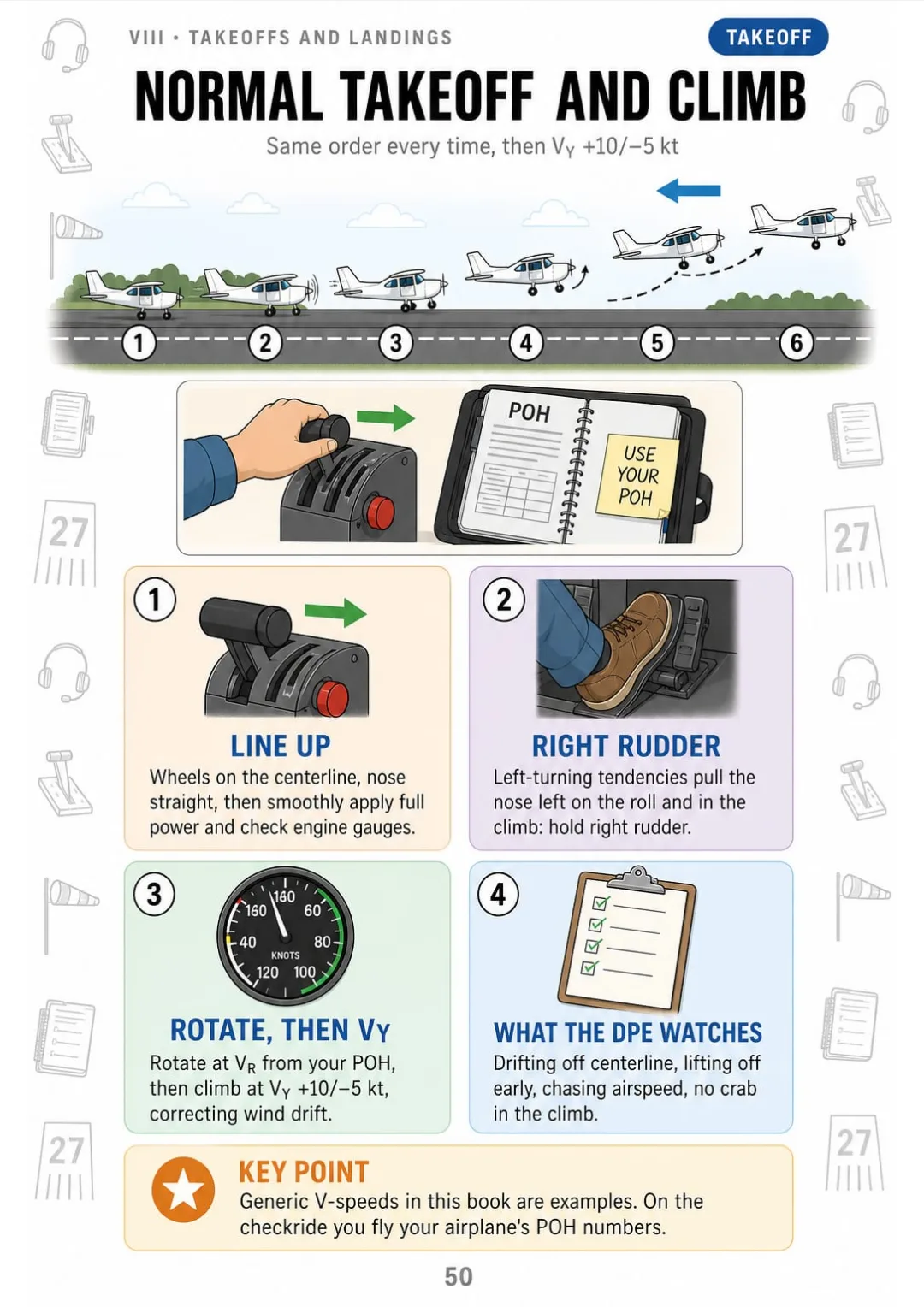
Pilot privileges, ARROW, 91.213, METARs, airspace, VFR minimums, steep turns, stalls and short-field landings: in your notes it's a wall of text. Here every topic fits on one page, with the drawing and what you need to remember. 78 illustrated pages.
🔒 Secure checkout · PDF by email · 30-day guarantee
One topic per page, the drawing that shows you how it's done and the boxes with what you need to know:


Swipe to see more →
These are real pages from the book. The table of contents is the full one: 11 parts and 73 topics.
You've read the list of required documents three times. You close the handbook...
...and you can't remember which ones have to be in the airplane and which can stay home. It was just lines of text.

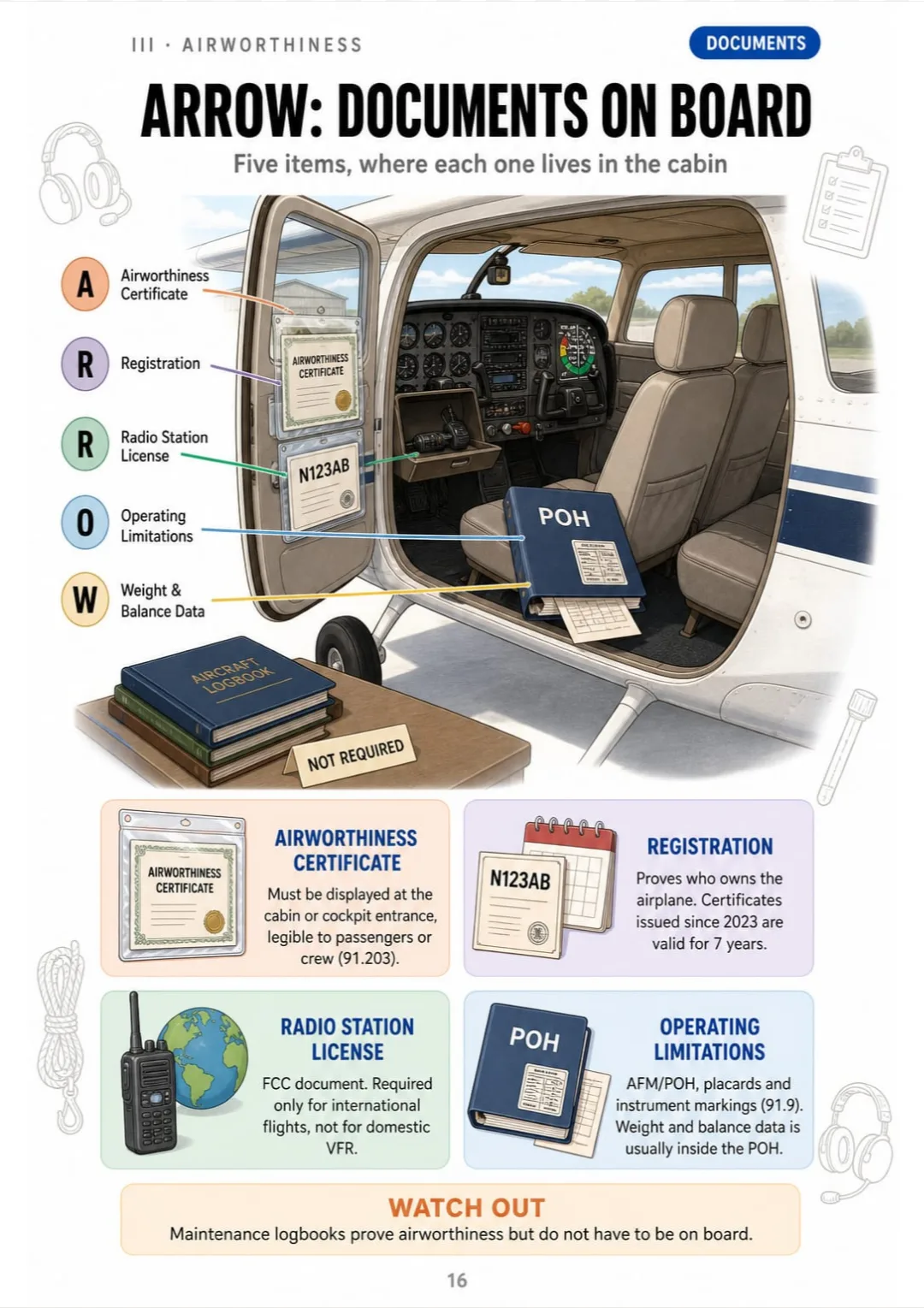
Here ARROW is one drawn page: the cabin with each document where it goes, letter by letter, and the logbooks marked as not required on board.
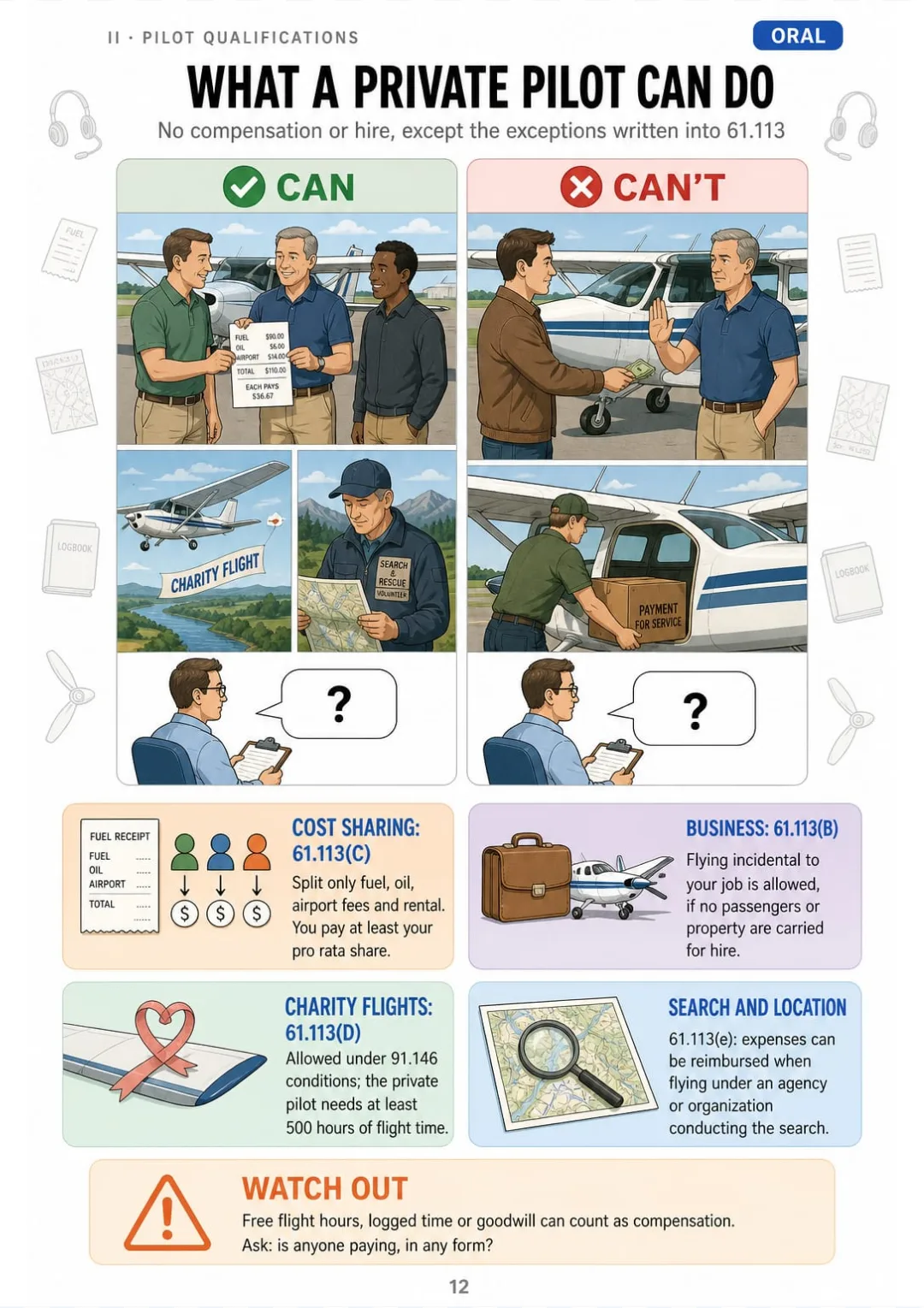
And on the pages next to it, every oral topic gets its own: privileges under 61.113, the required inspections, 91.205, 91.213 and VFR minimums.
First you understand why it works that way. Then the order sticks on its own.

Before the checkride, the oral (qualifications, airworthiness, weather, cross-country and airspace, systems and human factors), preflight and pattern, takeoffs and landings, maneuvers, navigation, emergencies and night, and the final review: 78 pages, all illustrated
Picture this:
Instead of rereading half a page on VFR weather minimums without being able to picture them...
...you open the page and find every airspace class side by side, with its visibility and cloud clearances, in a single table.

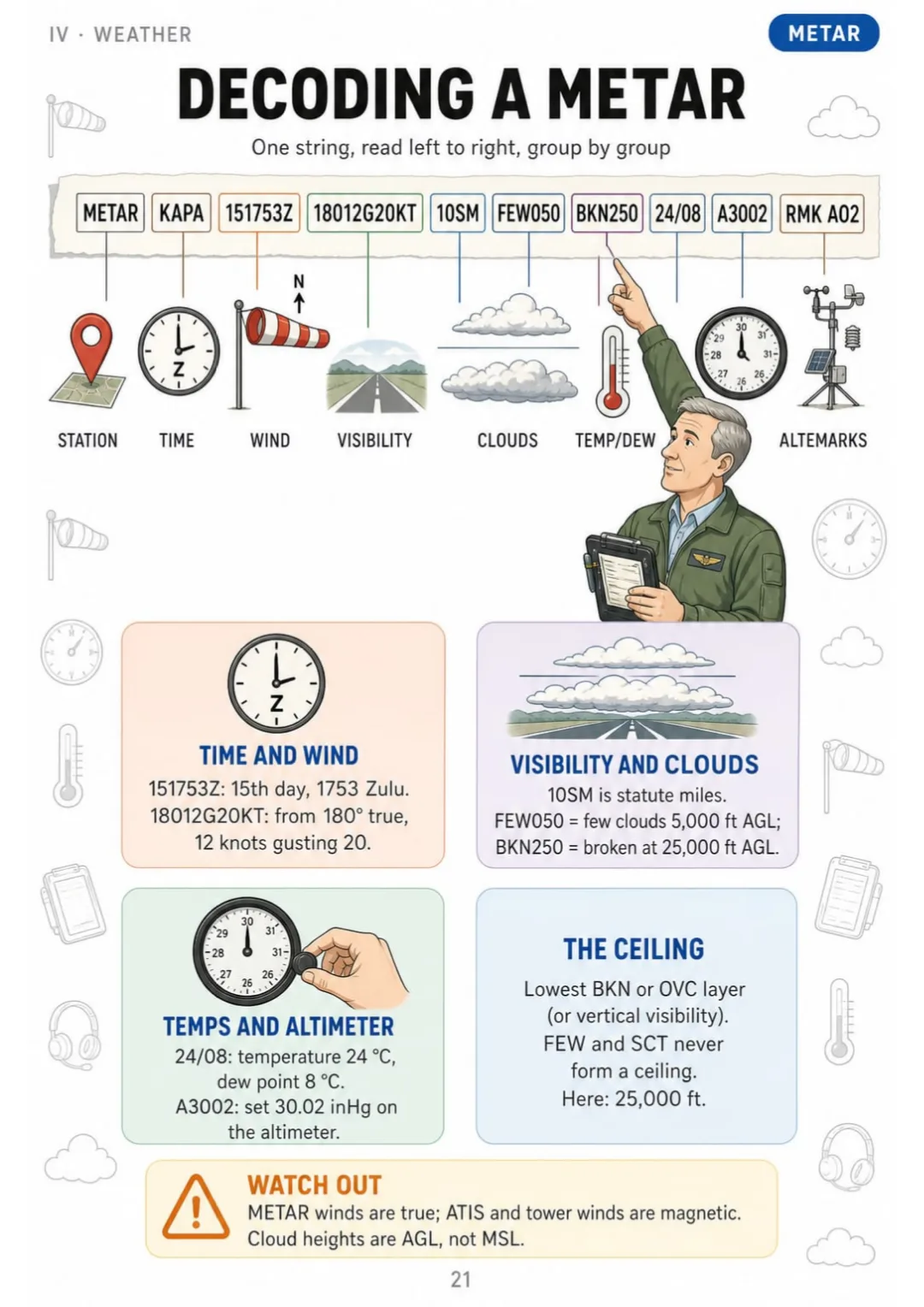
And 91.213, METARs, density altitude, steep turns and short-field landings turn into drawings and tables you read at a glance.
You stop repeating and start understanding.
That's exactly what Private Pilot Checkride Made Visual does. It's not “just another manual.” It's 11 parts and 73 illustrated topics, and at the end every tolerance on one page and a checkride day checklist. Because what your brain sees in order, it remembers.
Because what your brain sees organized, it remembers.
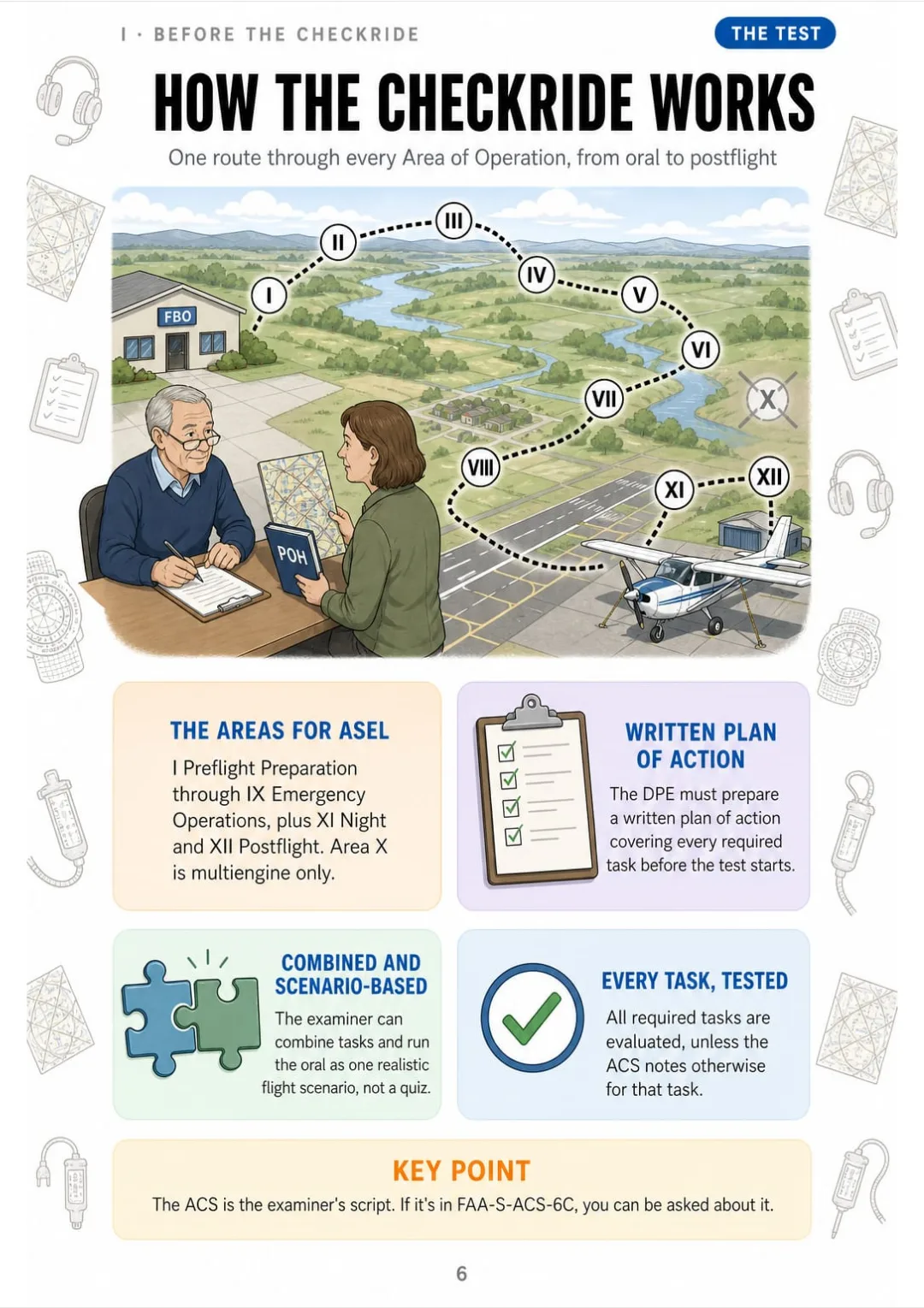
Walk in knowing what the test looks like: how the practical test works, reading the ACS codes, eligibility and the 61.109 hours, endorsements and IACRA, the possible outcomes and what makes the examiner stop the test.
Privileges and limitations under 61.113, flight review, passenger and night currency, third class medical vs BasicMed, and the documents you carry.
ARROW, the annual, 100-hour, ELT and transponder inspections, 91.205 day and night equipment, 91.213 step by step, ADs and special flight permits.
METARs and TAFs decoded, the GFA, AIRMETs and SIGMETs, fronts and clouds, thunderstorms, icing and fog, and the go/no-go decision.
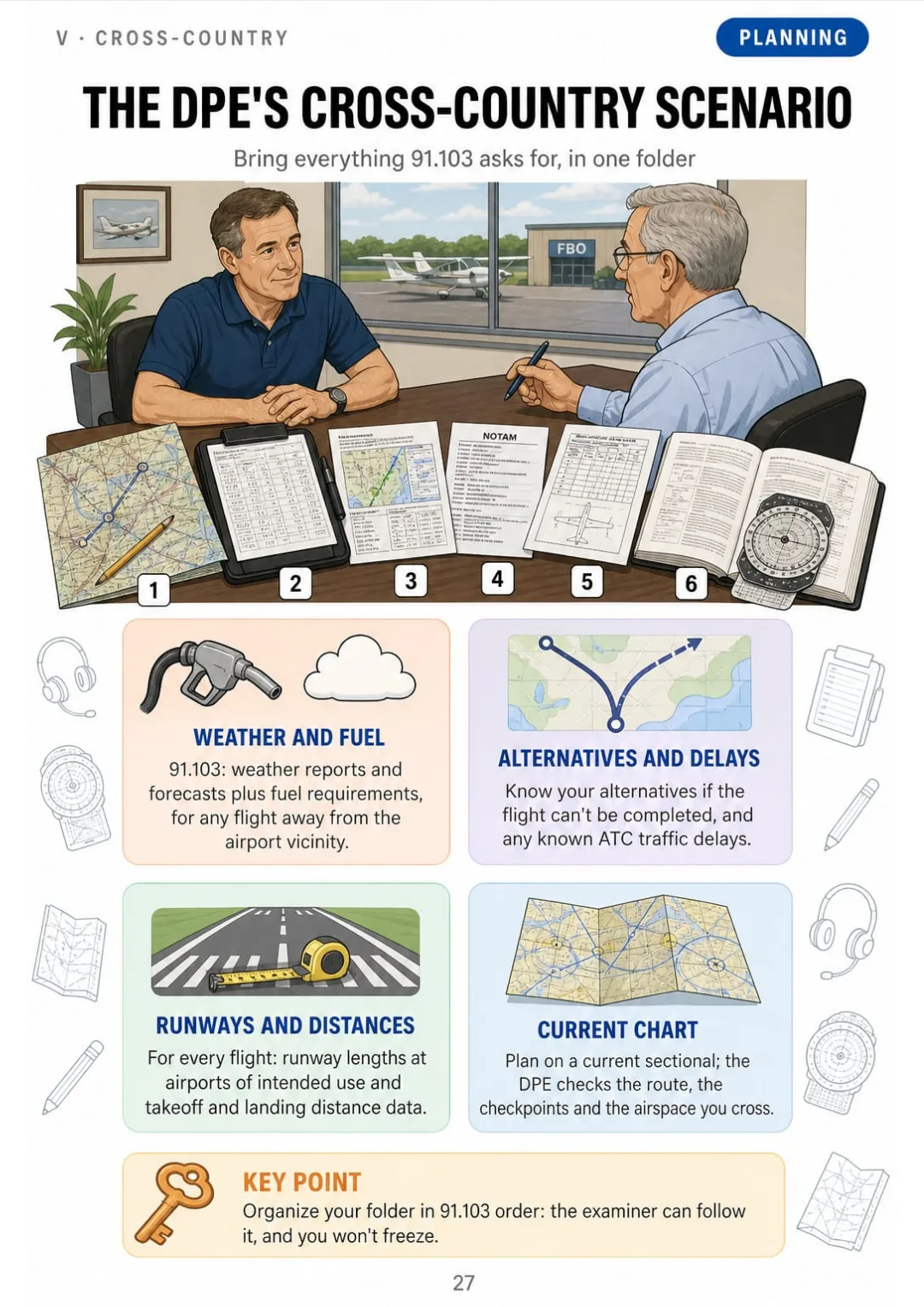
The examiner's cross-country, sectional symbols, true course to compass heading, fuel reserves, airspace and VFR minimums side by side, TFRs, density altitude and weight and balance.
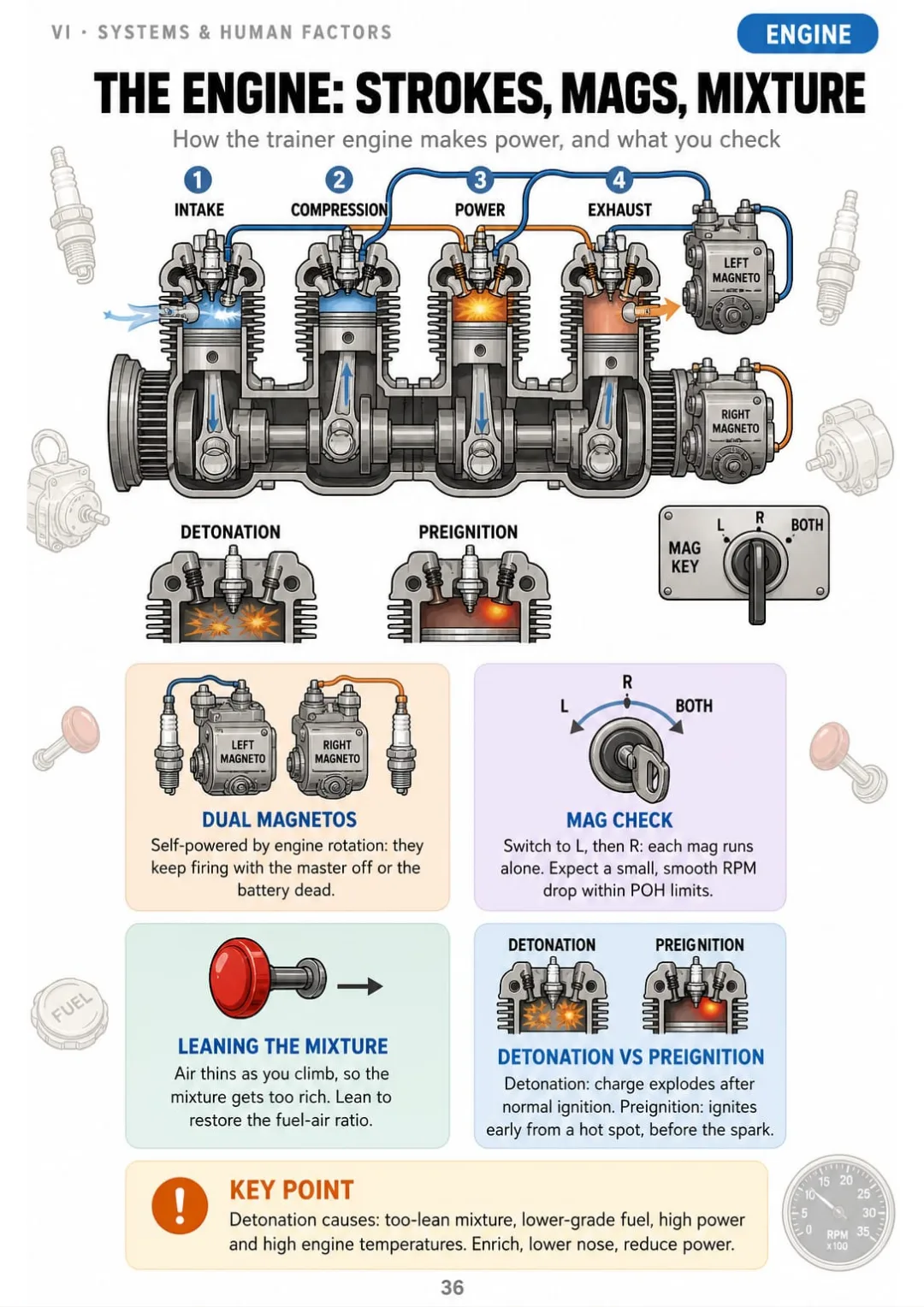
The engine, carb icing, fuel and electrical systems, pitot-static and gyro instruments, hypoxia and illusions, alcohol and drugs, and ADM with PAVE and IMSAFE.
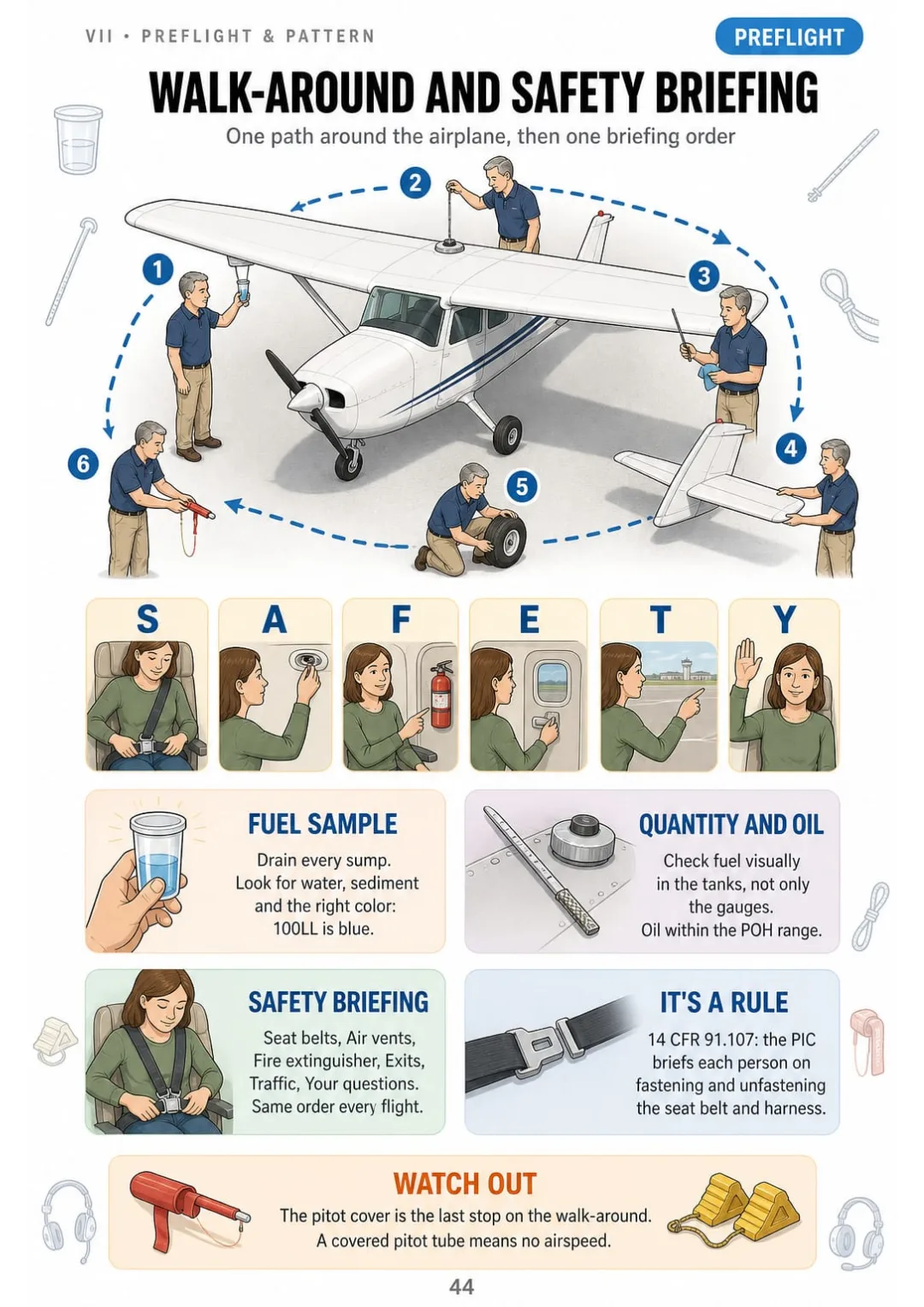
Preflight and passenger briefing, checklists, engine start, taxi and runup, radio calls and light gun signals, runway markings and the traffic pattern.
Normal, crosswind, soft-field and short-field takeoffs and landings, the forward slip and the go-around.
Steep turns, ground reference maneuvers, slow flight, power-off and power-on stalls and spin awareness, each with its tolerance.
Pilotage and dead reckoning, diversion and lost procedures, basic instruments and unusual attitudes, emergencies, systems malfunctions, night operations and securing the airplane.
Every tolerance on one page, the most frequent checkride mix-ups, the night before and the checkride day checklist.
At the end of the book: Every tolerance on one page, the most frequent mix-ups and a checkride day checklist.

Every single-engine land maneuver of the ACS on a pocket card: entry, key steps, the exact tolerances and the common errors the examiner watches for.

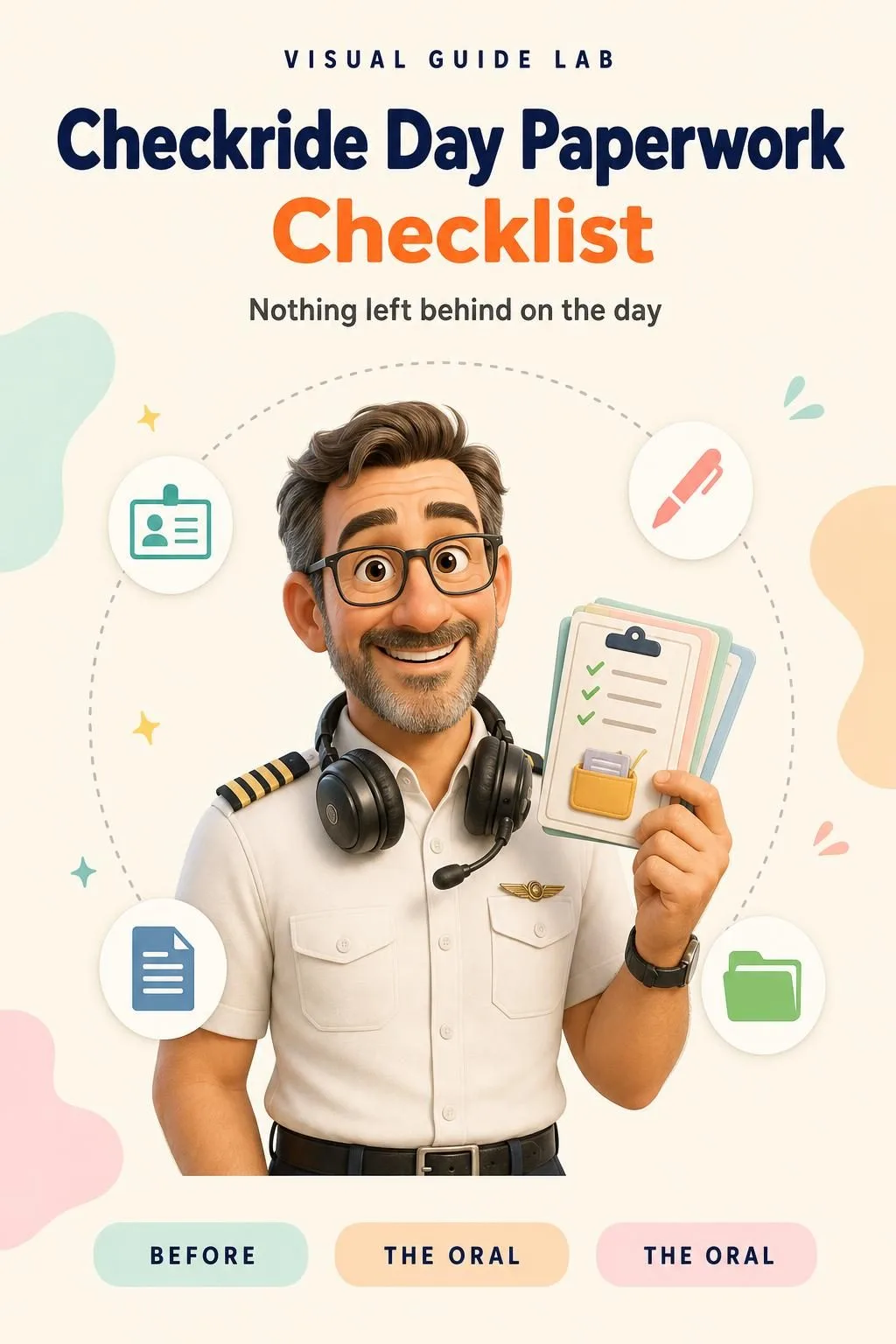
IACRA, the endorsements you need, your knowledge test report, medical or BasicMed, the aircraft documents and inspection entries to tab in the logbooks, and what to bring on the day.
📄 This is a digital PDF book sent to your email: nothing is printed or shipped.
PDF by email: Private Pilot Checkride Made Visual reaches your inbox as a PDF, and the two free books come by email too. One-time payment, no installments or hidden costs.
Regulations, weather and maneuvers, one topic per page, to review between lessons and ground sessions with your CFI.
Every ACS task in order for the final weeks, and at the end every tolerance on one page.
A quick visual refresher before your flight review: 61.113, 91.213, airspace, VFR minimums and the maneuvers.
📄 This is a digital PDF book sent to your email: nothing is printed or shipped.
30-day guarantee: tell us what didn't work and we'll refund 100%.
You have 30 days to try Private Pilot Checkride Made Visual and the two bonus books. If it doesn't work for you, email us, tell us what didn't work and we'll refund 100% of what you paid. One-time payment, no subscription.
Private Pilot Checkride Made Visual comes as a high-resolution PDF by email, to the address you enter at checkout, so you can read it on your phone or tablet or print it. The two bonus books, Maneuver Tolerance Cards and Checkride Day Paperwork Checklist, also come by email.
One-time payment of $27. No installments and no subscription.
For student pilots, Part 61 or Part 141, who have passed the knowledge test and are preparing for the Private Pilot Airplane Single-Engine Land checkride, and for private pilots who want a visual refresher. It's not a written test prep book: it starts where the written ends, and it works alongside your ground school or video course as the visual review for the final weeks. Check the table of contents above to see every topic.
On the Private Pilot Airplane ACS (FAA-S-ACS-6C), the Pilot's Handbook of Aeronautical Knowledge (FAA-H-8083-25), the Airplane Flying Handbook (FAA-H-8083-3), the Risk Management Handbook (FAA-H-8083-2), the AIM, 14 CFR Parts 61, 68 and 91 and 49 CFR Part 830. The medical page compares the third class medical with BasicMed under 61.23 and Part 68. Each page carries its ACS code, so you can check it against the current ACS edition listed on faa.gov before your checkride.
No. It's an independent study book, not affiliated with or endorsed by the FAA. The ACS, the PHAK and the AFH are free on faa.gov, and this book doesn't replace them: it puts them in order. Each ACS task gets a drawn page with the rule, the tolerance and the source it comes from, so the night before your oral you're reviewing 78 pages instead of searching through several handbooks. The airplane is a generic trainer, V-speeds are examples (always use your POH) and charts are redrawn for study, not for navigation.
No. It doesn't replace flight and ground training with your CFI, the required endorsements or your aircraft's POH/AFM. The pages on medical certification, hypoxia and alcohol cover exam content and are not medical advice.
No. Every DPE builds their own plan of action from the ACS. The examples and scenarios are written for this book and are not official questions from any exam.
Yes. The PDF is high resolution, so you can print the whole book or only the pages you need, and take the Maneuver Tolerance Cards to the table with your CFI.
You have a 30-day guarantee: tell us what didn't work and we'll refund 100%.
You don't have to reread the same page hoping it sticks this time.
You don't have to memorize regulations you can't picture.
And you definitely don't have to walk into your checkride not knowing where to start.
There's a simpler way. And it's one click away. Now it's your turn.
One-time payment: US$ 27 · Guarantee: 30 days · PDF by email
YES, I WANT PRIVATE PILOT CHECKRIDE MADE VISUAL FOR US$ 27📄 This is a digital PDF book sent to your email: nothing is printed or shipped.